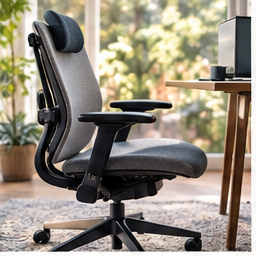
You pull the chair forward, but its arms hit the desk. You raise it to reach the keyboard, and your feet lose support. Those are different constraints, and a more expensive chair may reproduce both. The useful question is which adjustment is missing from the chair-and-desk combination.
Find your next step
Select the situation you recognize. This identifies a research route, not a compatibility approval.
Read the decision checks ↓Check the collision before changing the chair
With the chair occupied, roll toward the keyboard. Identify what stops you: armrests, a drawer, your knees or a thick rug. If the armrests adjust, lower them according to the chair instructions and repeat. Measure the underside clearance where the chair actually enters; the desk height printed in a listing can exclude a deep apron or drawer. Removing adjustable parts is only appropriate if the manufacturer permits it.
Set typing height, then assess the feet
Choose a position where you can reach the keyboard without repeatedly lifting your shoulders. Once that is set, notice whether both feet have stable support. OSHA describes footrests as an option when lowering the seat would leave the keyboard or monitor too high. That makes a footrest a response to a specific mismatch, not an accessory everyone needs. A stable temporary support can help you estimate the needed height before choosing an adjustable one.
Seat depth is a separate buying question
Sit back into the backrest. If the seat front presses behind the knees or you slide forward to avoid it, inspect whether the seat depth adjusts. A footrest will not shorten the seat. Conversely, an extremely short seat is not fixed by a tall backrest. Compare the usable seat dimensions and adjustment range with the positions you can comfortably use, rather than buying from overall chair height or a model photograph.
A sample shopping decision
Consider a fixed-height desk whose apron catches the current chair arms. If lowering the arms solves the obstruction and the backrest can now be used, a replacement is premature. If the arms cannot move and prevent every normal typing position, armrest range becomes a purchasing requirement. Write “must clear this measured apron height” on the shortlist. This is an illustrative case; it does not certify any chair for a particular body.
Read the return process before assembly
Chair returns involve more than a return-window date. Check whether the seller collects assembled items, expects original packaging or requires disassembly, and who pays freight. Keep the box until you have worked through typing, reading and calls. An attractive adjustment specification is not useful if the control cannot be reached while seated or if the seat position changes when you lean back.
When furniture shopping is the wrong next step
Persistent pain, numbness or weakness deserves qualified medical advice. This article helps compare furniture fit; it cannot identify the cause of symptoms. Do not interpret a better-looking posture or an “ergonomic” badge as proof that a product will treat a health problem.
The decision at a glance
| Observation | Investigate | Avoid assuming |
|---|---|---|
| Cannot approach keyboard | Armrest and drawer clearance | A new chair automatically fits |
| Feet unsupported at typing height | Foot support and seat range | Lowering the seat solves everything |
| Seat presses behind knees | Seat depth and adjustment | A cushion will correct the dimensions |
Replace a chair for a documented adjustment limit. Add a footrest only when it solves the remaining support gap.
Products for the relevant scenario
These are research candidates for the conditions above. Verify the exact variant and seller’s return terms before buying.

HUANUO Adjustable Foot Rest
Consider it for: A chair set for typing that leaves feet without stable support.
Before buying: Measure available legroom and needed support height.
Trade-off: It cannot correct an unsuitable seat depth or broken chair.
View product →Sources and evidence
Based on product documentation and the sources below; DeskWise has not hands-on tested these products. Examples describe possible setups, not measured outcomes.
Editorial update: Jul 08, 2026. Product images correspond to their linked retailer pages. Prices and stock are left to the seller’s page.